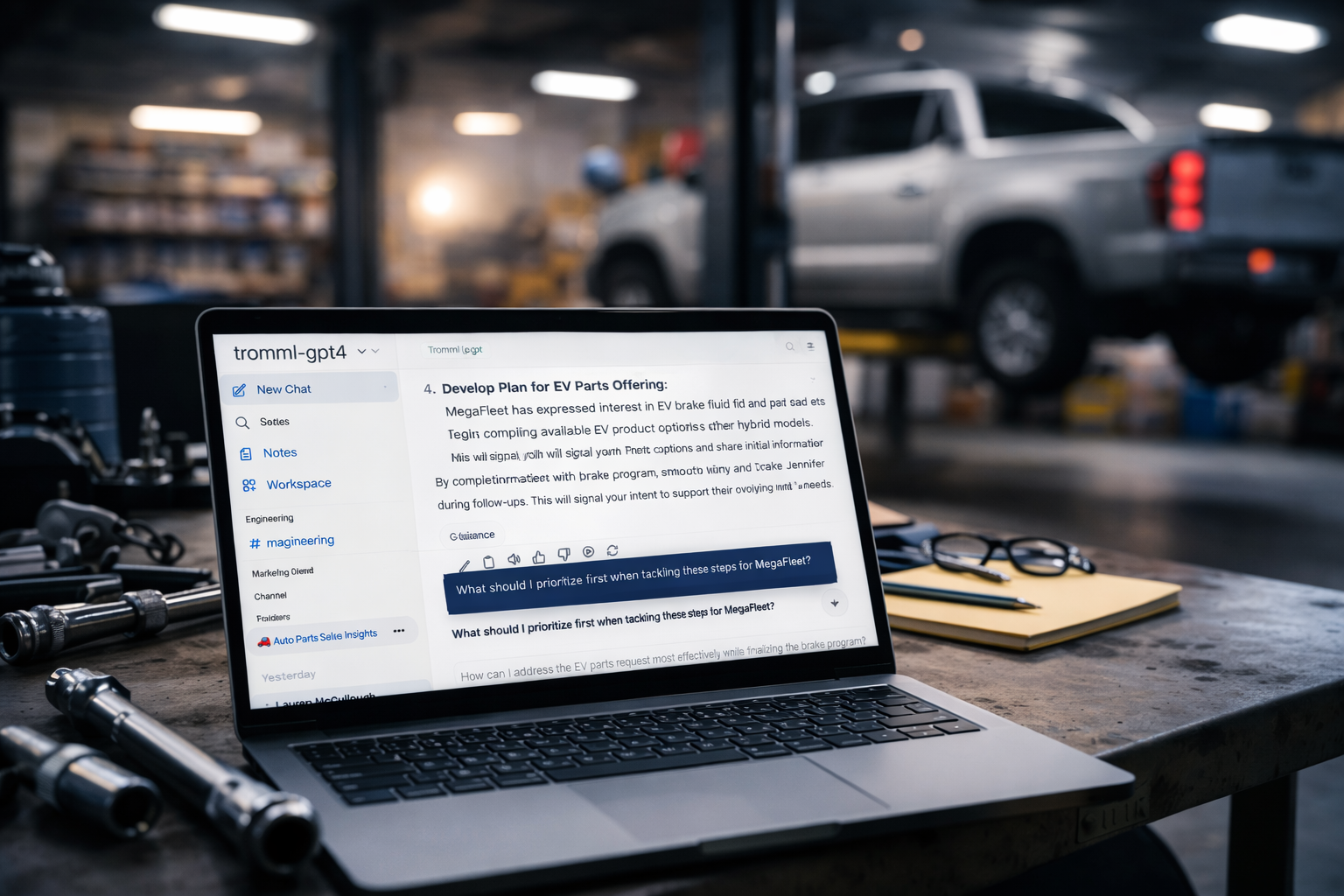
I had just received the Auto Care Under 40 Impact Award when I left to go do the thing that made the recognition matter most: sit down with commercial vehicle professionals and help make AI practical.
The timing stuck with me.
I am deeply honored by the award. I do not take it lightly. This industry has given me opportunities I never expected, challenged me in all the right ways, and pushed Tromml to become better, sharper, and more useful. But the more I sit with it, the more I keep coming back to the same thought: awards are not the point. Awards are a signal.
They are a signal that the work matters. That the industry is paying attention. That the conversations around AI, data, sales enablement, and the future of the aftermarket are becoming more real. The real standard is what we do with that recognition.
For me, that meant leaving an awards moment and heading to CVSN Education Week to work with people trying to understand what AI can actually mean for their teams, their customers, and their companies. And that experience reminded me of something I believe more strongly every day: the aftermarket is not behind on AI. It has been given the wrong starting point.
There is a narrative that parts of this industry are too traditional, too skeptical, or too far behind to adopt new technology. I hear it often, especially when people talk about commercial vehicle teams, independent distributors, counter teams, and long-standing businesses that have not been built around flashy tech stacks.
I do not buy it.
What I have seen is not an industry that cannot learn. I have seen an industry that has been asked to care about technology before the people building it understood how the industry actually works. That is a very different problem.
When AI is presented as hype, people tune out. When it is presented as a generic tool, people struggle to connect it to their day-to-day work. When it is framed like something only the IT team or executive team needs to understand, frontline teams assume it is not for them.
But when you sit down with aftermarket professionals and use real examples, something changes.
At CVSN Education Week, someone came up to me after one of our sessions and said:
"I was really skeptical about all this AI stuff, and I've honestly really veered away from it, but by being able to actually use real examples, it's the first time I not only understand this technology can help me but how it can make our entire company better."
That is the moment I cannot stop thinking about. Because that is not just a nice comment after a workshop. That is the actual unlock.
The goal is not to convince people that AI is cool. The goal is to help people see where it fits in the work they already do. Preparing for a customer visit, spotting accounts going quiet before revenue drops, turning messy conversations into structured follow-up, connecting what the field is hearing with what the business is deciding. That is when skepticism turns into curiosity. And curiosity turns into capability.
This matters because the aftermarket is full of knowledge that never makes it into the systems companies rely on to make decisions. A rep hears that a customer is frustrated with availability. A counterperson hears a competitor is gaining ground. A manager knows a key account has started acting differently. Too often, that information lives in someone's gut. Thirty, sixty, ninety days later, the business sees it in the numbers and by then, it is already late.
This is why I believe the next era of AI in the aftermarket will not start with the fanciest model or the flashiest dashboard. It will start with better visibility. Before companies can get better at pricing, inventory, forecasting, or retention, they need a better signal from the front line.
That signal already exists. It is sitting inside the conversations your team is having every day. The opportunity is to capture it, organize it, and turn it into action.
That is the part of AI that gets me excited. Not replacing the people who know this industry — supporting them. Making their knowledge easier to use. Helping managers see what their teams are hearing. Helping companies act sooner. Helping independents compete with larger organizations that already have systems and analysts dedicated to finding patterns before they become problems.
The companies spending the most on AI are often trying to learn what great aftermarket people already know. The difference is whether that knowledge gets captured and used.
That is also why training matters so much. A one-time demo does not change a company. A clever prompt does not create adoption. A tool alone does not create a strategy. AI adoption happens when people can connect the technology to real work. It happens when teams feel safe enough to try, supported enough to keep going, and clear enough on why it matters.
That is where a lot of companies get stuck. They know AI is important. They know they need to do something. But they do not know where to start. So they either let people experiment on their own, which creates risk and inconsistency, or they wait for a perfect enterprise strategy, which slows everything down.
Neither approach really works for the aftermarket.
This industry needs a more practical path. That is why we built the Gold Standard Program.
Gold Standard is not another AI tool to add to the pile. It is the operating muscle to use AI well — built around a simple belief: you cannot improve what you cannot see. If reps are hearing customer risks, competitive pressure, product issues, and new opportunities every day, that should not disappear into scattered notes or individual memory. It should become intelligence the whole company can use.
That foundation is what makes the rest of AI more valuable. Pricing AI gets better when it is connected to what customers are actually saying. Inventory decisions get stronger when they are connected to real demand signals. Forecasting gets sharper when it is informed by what is happening in the field. Sales leadership gets more effective when managers can see activity, follow-up, risk, and momentum before the numbers tell the story too late.
That is the standard this industry deserves. Not a vendor who drops in, gives a presentation, and disappears. Not a generic AI tool built for some other market and lightly rebranded for this one. Not a technology strategy that ignores the people who carry the relationships, knowledge, and customer context inside the business.
The aftermarket deserves partners who are willing to do the work.
We care enough to show up. We care enough to ask better questions. We care enough to sit with a room of skeptical people and not judge the skepticism, but work through it. We care enough to learn the workflows, the language, the friction, and the reality of how teams actually operate. We care enough to build with the industry, not around it.
That is why we have been able to earn trust in rooms that larger vendors sometimes struggle to enter. It is not because we are bigger or have been around longer. It is because people can feel when you are there to sell them something, and they can feel when you are there to help them move forward.
That distinction matters, especially right now.
AI is going to change this industry. The question is whether the change will be something that happens to aftermarket companies, or something they actively shape. I believe the companies that win will not be the ones that wait until everything is perfectly clear. They will be the ones that start building the muscle now — practical use cases, trained teams, protected data, better field signals, AI connected to the work that actually drives revenue, retention, and profitability.
And they will do it without losing what makes this industry great: relationships, trust, grit, and deep knowledge of the customer.
That is what CVSN reminded me. People are not afraid of AI because they are incapable of learning it. They are cautious because they have not always been shown how it connects to their world. Once they see it, the conversation changes.
The moments that keep me motivated are smaller than the awards:
That is why this work matters. The award reminded me that the industry is watching. CVSN reminded me that it is ready. Tromml is here to keep doing the work to help it move forward.
Read FREE Tromml's eBook on how AI is changing work in aftermarket parts distribution.



%401x.svg)