There's a version of AI's future in the aftermarket that gets pitched at every trade show: fewer reps, an automated counter, a model that takes the order. I think the companies chasing that version are going to lose to the ones doing the opposite.
That's not sentiment. I spend my weeks with distributors, suppliers, and rep agencies, and the same pattern keeps showing up: the businesses getting real value from AI are using it to make their people harder to compete with, not cheaper to remove. We just published a whitepaper making the full argument. This is the short version, and my opinion on why it matters right now.
The urgent problem isn't reps going away. It's reps retiring.
The aftermarket digitized the transaction, not the relationship. A shop can find inventory, check a price, and place an order without talking to anyone, and still gives the business to the people it trusts.
The real clock that's ticking is a different one. The share of wholesale-trade employment at companies where at least a quarter of workers are over 55 went from 14% in 2000 to more than 40% in 2022. Distribution's most experienced people are aging out, and what they carry doesn't transfer with the territory. A shop owner told us: "I used to have reps that came in to do real business. These younger guys tend to come by and drop off a flyer and move on to their next stop."
A new rep can inherit the account list. They don't inherit twenty years of knowing which customer is worth the extra call, who might try a new line, or what was said in a shop six months ago. Replacing the headcount is not the same as replacing the capability. That's the problem worth spending money on.
Nobody holds the whole story
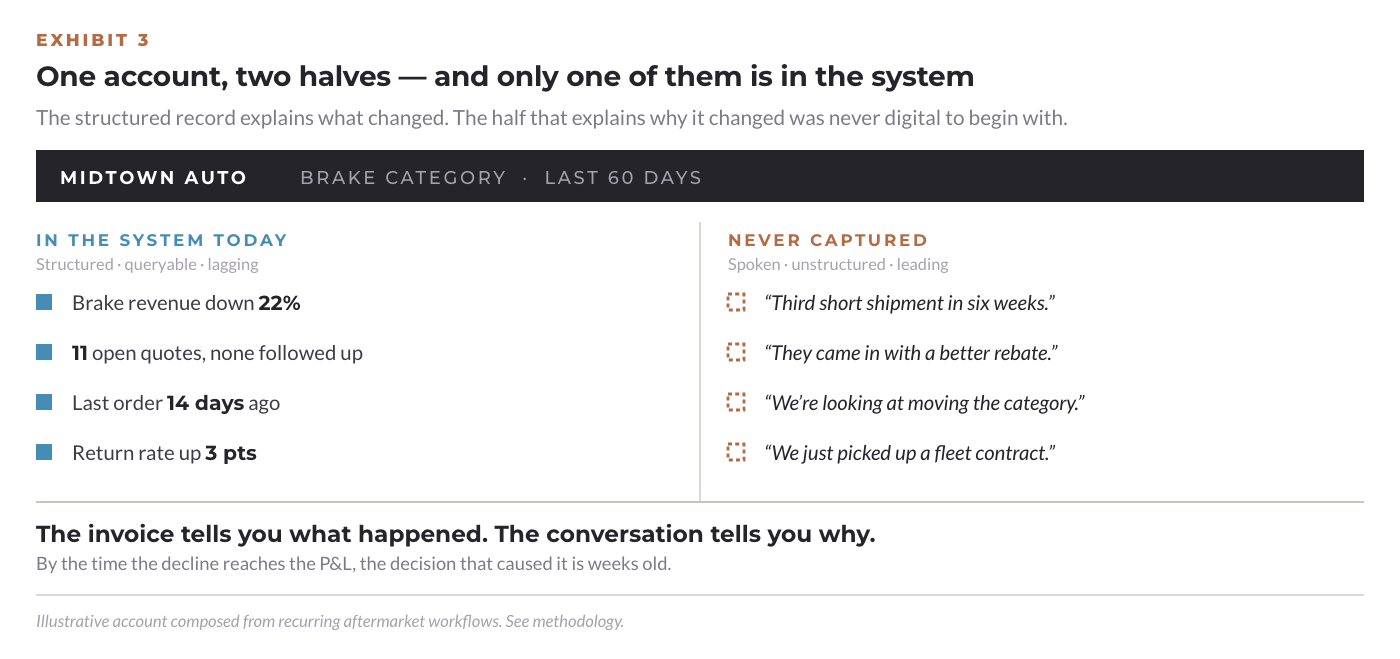
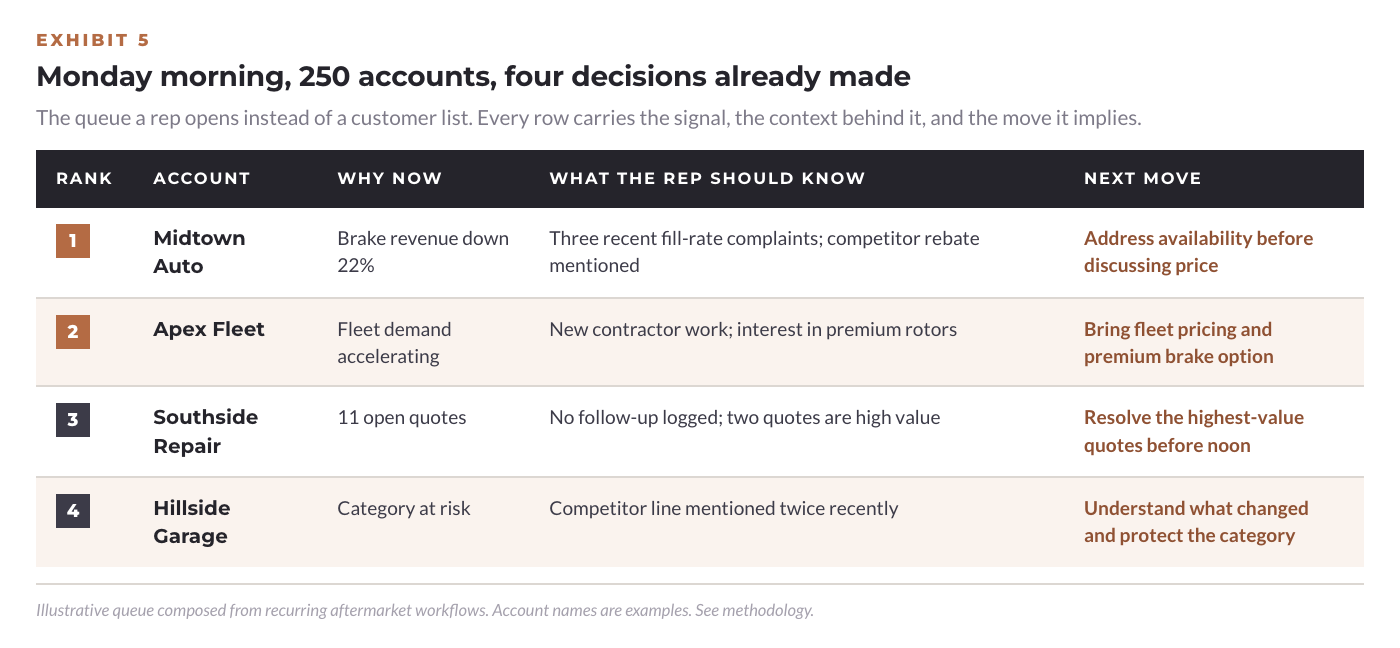
Picture one shop account. The system knows brake revenue is down 22%, eleven quotes are sitting open, and the last order was two weeks ago. Meanwhile the rep knows the owner has been complaining about fill rates for six weeks. The counter took the call where the shop said "that's the third one that didn't fit." And somebody heard they just picked up a fleet contract.
Half of that account lives in the system. The other half, the half that explains why, was never written down anywhere.
Why does it never get written down? Because the record depends on someone stopping selling long enough to type. Every field skipped at six o'clock on a Thursday is context the business will not have on Monday, and it does not come back.
This is why so many AI pilots die. Gartner puts it at 89% that never make it past the pilot, and everyone blames the model. Honestly, the model is fine. It's working with half the story.
Reps were never the resistance
Every leader expects reps to push back on being recorded. It runs backwards. The resistance was never to talking. It was to forms. Nobody took a sales job to spend the evening typing into a CRM, and no amount of training changes that.
Here's a test I give people in workshops. After a conference, don't wait until Monday and try to reconstruct the week from business cards and half-remembered conversations. Open a voice note on the walk back to the hotel and talk: who did you meet, what did they care about, what did you promise. One supplier team did the full version of this at a single trade show, about 250 voice notes captured across the event. Structured and analyzed, those notes surfaced an estimated $9 million in pipeline that would otherwise have gone home in a bag of business cards.
That's what happens when you ask reps to do the thing they're already best at. Across our deployments we see three to five times more notes captured when the interface is one button and their own voice, and the heaviest users are usually the most senior people on the team. They know the most and type the least.
The counter is half the relationship
Field reps get the long conversations. The counter gets the volume. In our work with distributors, a professional line routinely takes 150 to 200 calls a day from shops, and those calls are not just service events.
A shop calls asking where the driver is. The transaction answer is an ETA. The better answer might be: "While that truck is still headed your way, do you want me to add your normal stock order?" Same call, very different value, and the difference is whether the person answering can see the account's story.
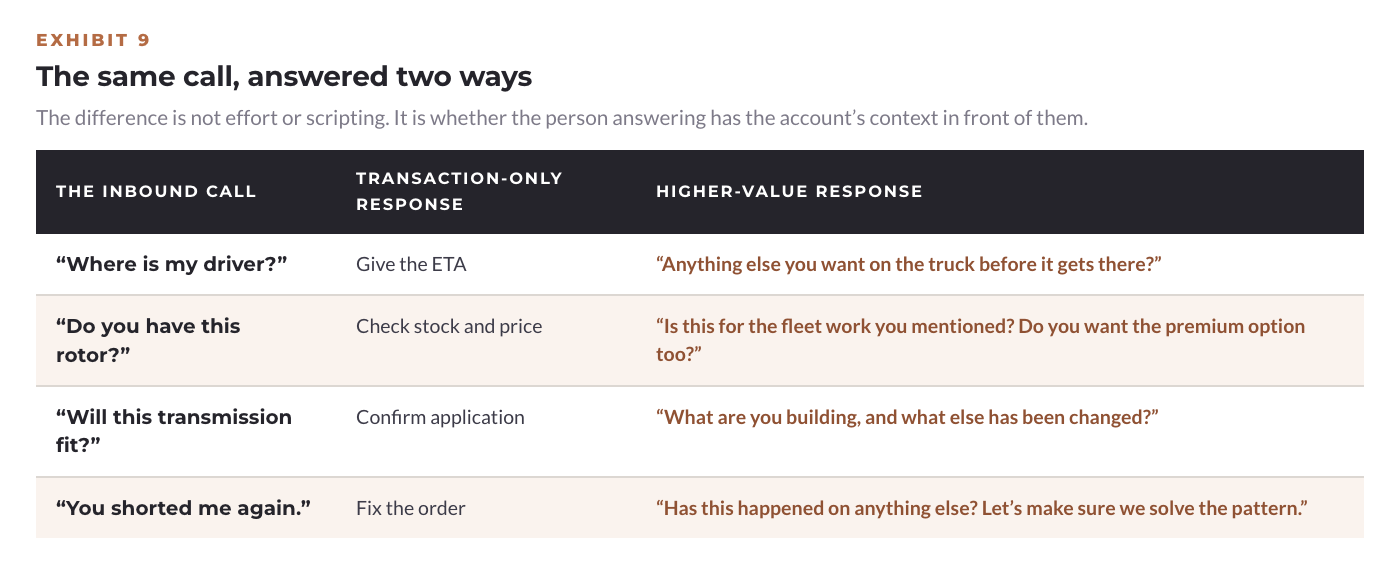
The counter also hears things first. "Your fill rate has been terrible." "We've been buying that line somewhere else." "That's the third one that didn't fit." Said once, none of it is worth stopping to write down. Said fifty times across a month of calls, it's an early warning. The call is often the smoke detector. The P&L is the fire report.
What changes when the team shares one memory
Once what gets said becomes data, the pieces start working as one system, and this is the part I think most people underestimate.
The rep who captured the fleet-contract comment doesn't just help herself. The next counter call on that account opens with the history in view, and the counterperson asks about the new trucks instead of just quoting a part. Six shops mention the same fitment problem, and it becomes a quality investigation instead of six shrugs. A competitor's name shows up across one territory, and management sees the pattern before it becomes a regional revenue problem.
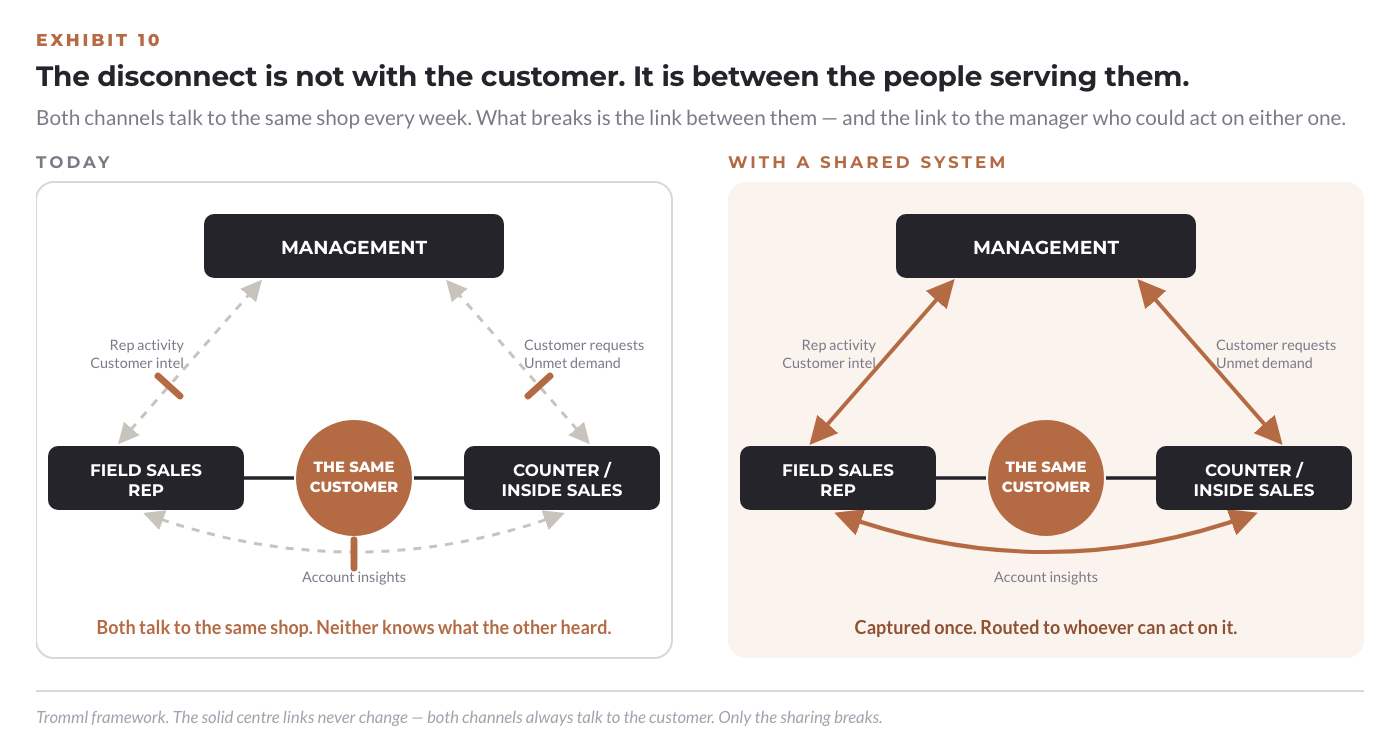
The manager might be the biggest winner. Twenty-five reps capturing ten conversations a day is 250 interactions flowing back into the organization, and no manager reads 250 notes a night. They shouldn't have to. A system that reads across all of it can hand them three things: what needs you today, the patterns underneath, and what's working well enough to coach across the team.
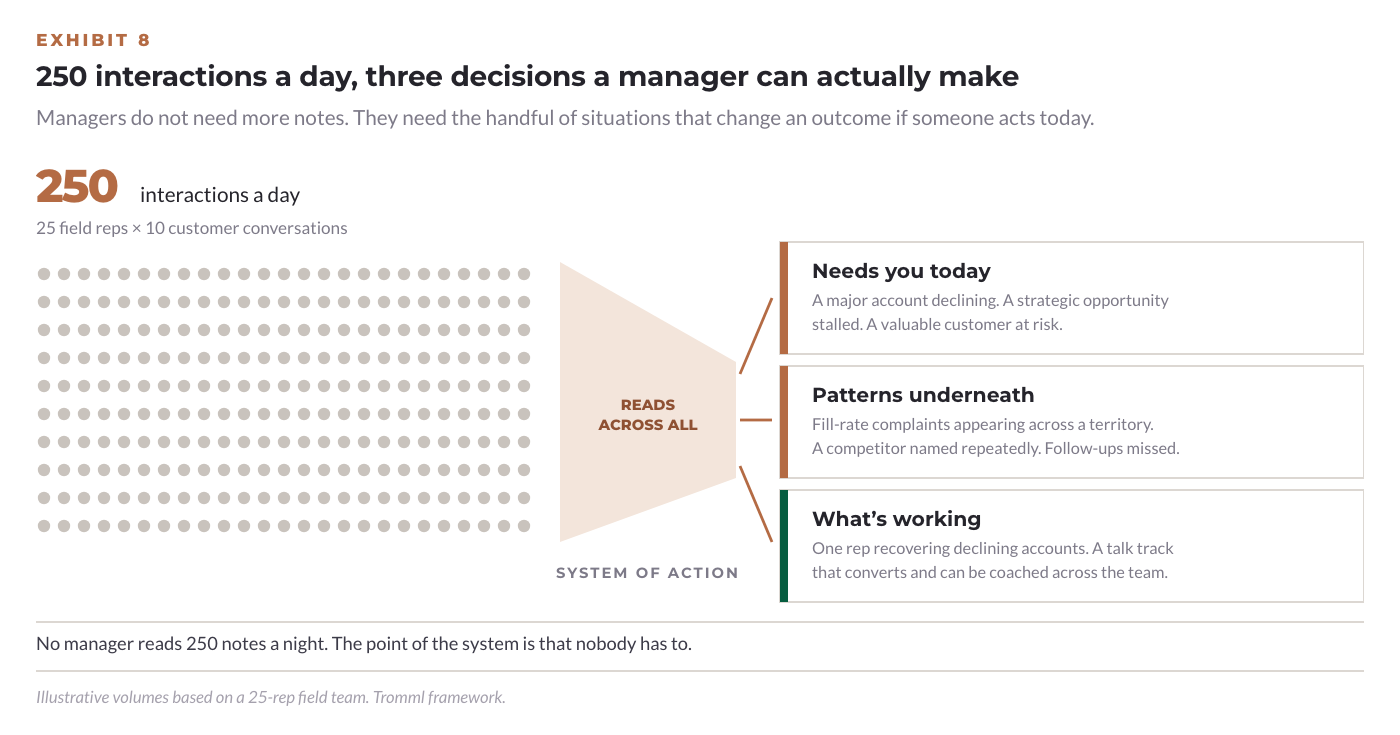
And the rep's Monday stops being a guess. Instead of 250 accounts and a spreadsheet, the week opens with a short ranked list and a reason behind every name.
One warning: it has to speak the trade
A general-purpose AI tool can transcribe a call and summarize it well. That doesn't mean it knows that a line is a brand you can win or lose, that dating changes when the invoice comes due, or that "the third one that didn't fit" is a fitment pattern on a specific part that has now appeared at three accounts. That's not a model limitation. It's a context limitation, and context is the part that has to be built for this industry. Before you buy anything, ask the vendor what a kit is. Enjoy the silence.
Where this lands
The companies that win the next decade won't be the ones with the fewest people. They'll be the ones where every person has more behind them: the rep who walks in already knowing what changed at the account, the counterperson who turns an inbound call into the better question, the manager who coaches from patterns instead of anecdotes.
Your CRM is the system of record, and it can stay that way. What's been missing is the system of action that sits on top: the connected memory the rep, the counter, and the manager all work from, deciding what deserves attention today.
The whitepaper makes the full argument: the research base behind every claim here, the dollar math on what better account prioritization is worth on a real field team, the four realities any capture system has to survive, and what the distributor workforce looks like in 2035 if this goes the way we think it will. Twenty-eight pages, twenty exhibits, every claim sourced so you can check our math.
Free, no form. And if you'd rather see this on your own accounts than read about it: send us 30 days of rep notes or call transcripts and we'll show you what's already sitting in them. Get a Free Analysis →