Minecart for distributors
Turn what your reps hear into where they go next.
Your tracker can prove a rep parked at a shop for ten minutes. It can’t tell you whether a sales call happened, what the customer said, or whether the account that quit buying a category got a visit. Minecart captures the conversation, watches the categories, and turns both into each rep’s plan for tomorrow.
The problem
You can see the stops. You can’t see the selling.
Most distributor sales teams run on a stop-tracker and a spreadsheet. You know when reps started their day and how many stops they made, and that’s about it. Whether a real sales conversation happened inside, whether the campaign got mentioned, whether the customer is drifting to a competitor, none of it shows up until it shows up in the numbers.
And the numbers hide it. Sales can be up on the strength of your best people while half the territory just maintains, and the only way to know is for you or your ops person to stop what they’re doing and go dig. There is a gap between what you want the team doing and what you can get them to do, and a bigger carrot every quarter is not a strategy. Minecart closes that gap with visibility on one side and a plan on the other.
What changes
From tracking activity to directing it.
Every rep starts the day with a plan, not a route.
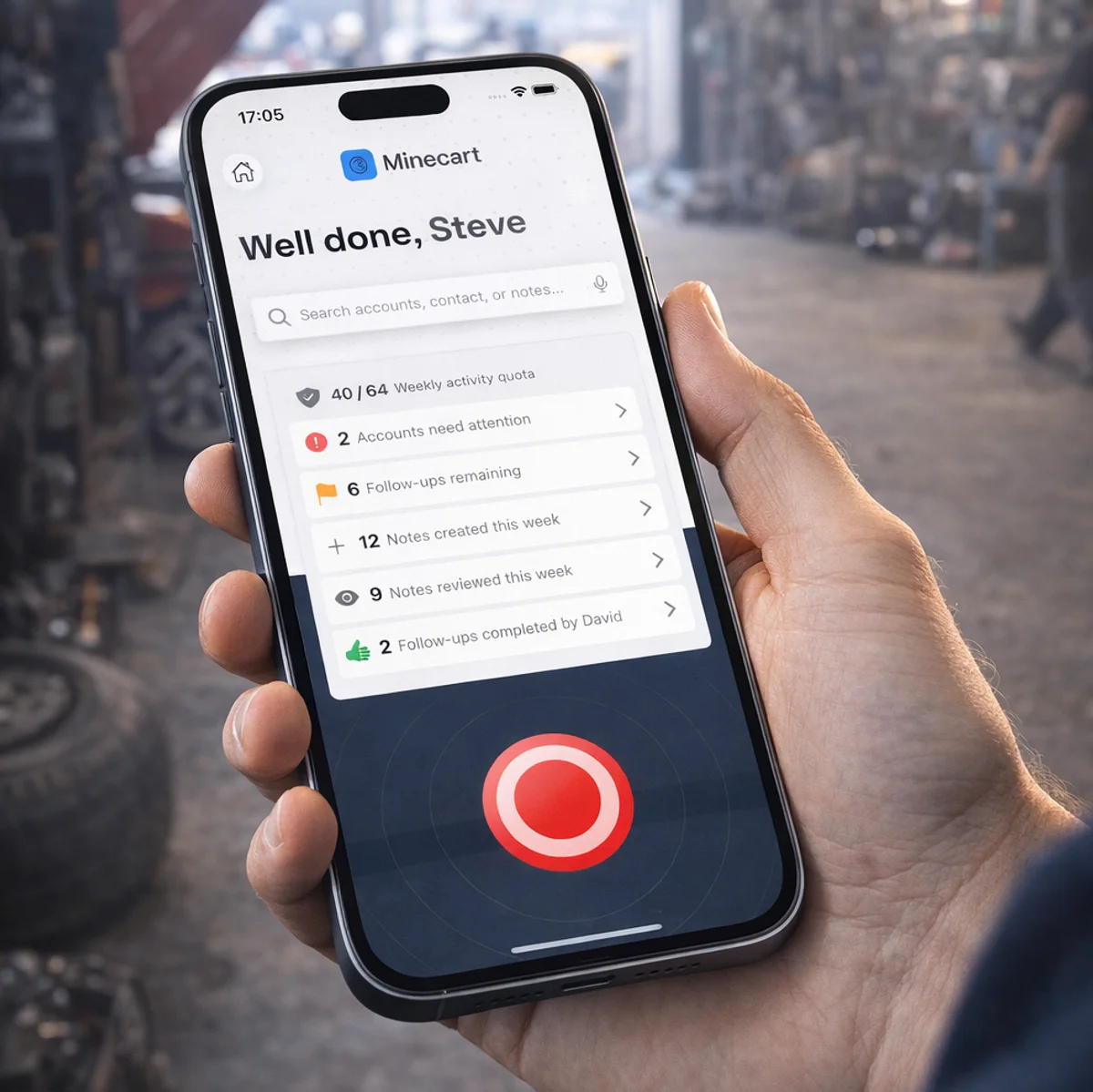
Minecart builds each rep's day from what actually needs attention: the account that went quiet, the category that dropped, the opportunity somebody mentioned last week, the visit that's past due. Not the same loop they've been driving for years.
Campaigns get executed, not just announced.
When you launch a push on a product line, you see who's running the play and who isn't, account by account, while the campaign is still live. Not sixty days later when the numbers come in and it's too late to fix.
Category drop-offs get caught the week they happen.
An account quietly stops buying brake pads or ride control, and both you and the rep get told, while it's a conversation instead of a lost line. No more finding out at the end of the quarter from a report somebody had to pull.
Reps believe it, because they can see it.
Telling a rep which accounts deserve their time rarely works. Showing them does. Reps see the same signals managers see, on their own screen, so the argument about where to spend the day ends.
Tailored action plans
Every rep starts the day knowing where to go, and why.
Behind every rep is a ranked pool of accounts that need them next: an urgent alert on an account that stopped buying, an open opportunity, a visit that’s past due, an emergency you routed in that morning. Minecart turns that pool into a focused daily plan per rep, built around your priorities, not around whichever shops are easiest to stop by.
Reps can take the plan as-is, pick from a few options, or build their own. Either way, every account on it comes with the context to walk in prepared: what was said last time, what was promised, and what to bring up today. The rep who covers 180 accounts stops carrying all 180 in their head.

Campaign monitoring
Set the action. See it happen.
The usual way to move a product line is a sixty-day push and a carrot, and then you wait for the numbers to tell you whether anyone actually ran the play. Reps learn the rhythm, save up the easy wins, and the incentive stops changing behavior.
Minecart makes the campaign itself visible. Launch a push on ride control and watch it execute: which reps are having the conversation, at which accounts, what customers are saying back, and who hasn’t touched it, while there’s still time to redirect. The laggards stand out mid-campaign instead of after the quarter closes, and coaching happens from what was actually said, not from a leaderboard.
What gets surfaced
The signals that tell you where to focus next.
Category alerts
Major categories, watched per account. When rotors, ride control, or exhaust goes quiet, or suddenly comes on board, you and the rep both hear about it.
Account risk
Accounts going quiet, pricing left unresolved, a competitor mentioned twice in a month. Surfaced while you can still do something about it.
Campaign execution
Who's talked about the push, at which accounts, and who hasn't touched it. Coverage you can see mid-campaign, not a surprise at the end.
Follow-up risk
Every promise your team makes, tracked until it is kept. Nothing left waiting on someone's memory.
Coverage gaps
Which accounts have slipped past their call cadence, and where rep attention needs to go this week, without asking anyone for a status update.
Competitive intelligence
Which competitors are getting mentioned, on what, and where, aggregated across every rep in the territory.
How it works
Simple enough that your team actually uses it.
One-tap capture
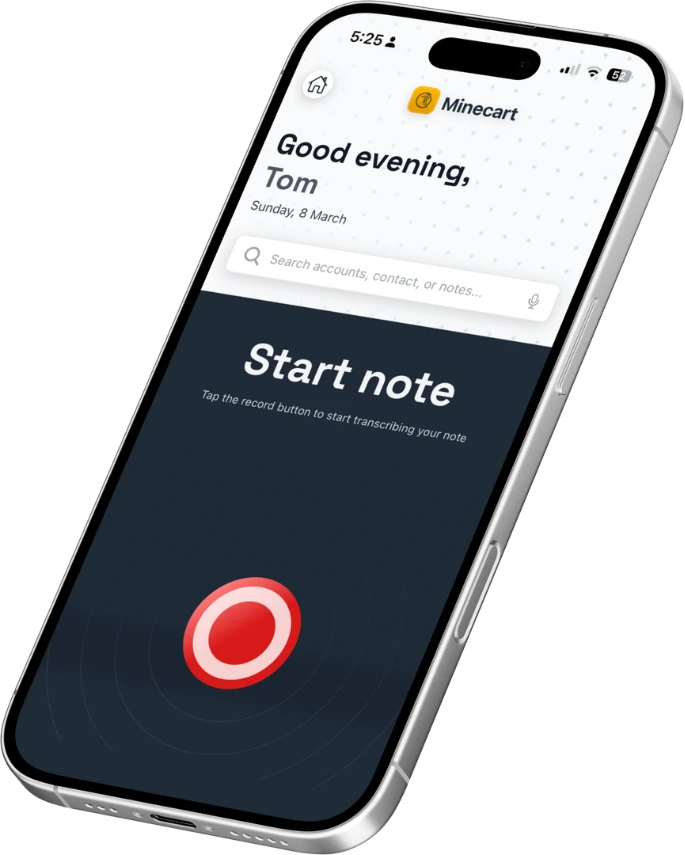
Voice first, works offline. A rep talks for a minute after a visit, and Minecart takes it from there. No account to select, no fields to fill. That is the only step the rep ever does.
The work gets done for you
The note gets structured, follow-ups get pulled out, the account gets matched, and signals get flagged, automatically. Nobody on your team writes a call report.
Signals surface to managers
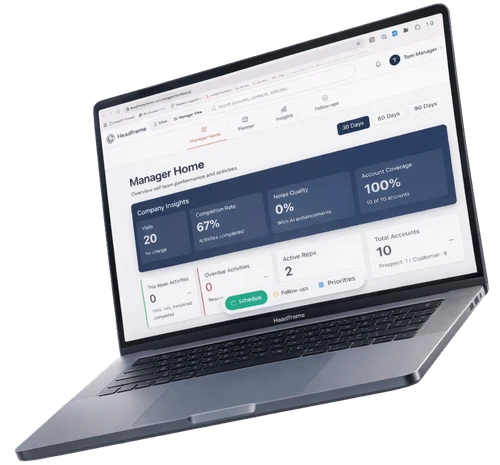
The few things that need action this week land in front of your managers, prioritized: the category that dropped, the campaign nobody's running, the account going quiet.
The plan comes back down
Those signals become each rep's next day: which accounts to hit, why, and what to bring up when they walk in. The loop closes without anyone pulling a report.
Also at the counter.
The same one-button capture works for counter and customer service teams. When a call or walk-in surfaces something worth keeping, a pricing complaint, a competitor mention, a lead, it rolls into the same account history your reps and managers already see.
For the sales manager
Not another system your team has to be talked into.
Every manager who has rolled out a CRM has asked the same three questions. Here is how Minecart answers them.
Will people actually use it?
One button, thirty seconds, works offline. No account to select, no fields to fill in later from memory. That is the difference between something that survives a full day in the field, and the CRM fields that quietly stop getting filled out after week two. It works even when your team isn't data-savvy, because nobody has to be.
Does it actually give them something to act on?
Minecart is not a place to store what happened. It is built to tell your team what to do next: the daily plan, the follow-up that is slipping, the category that went quiet, the campaign that needs a push. A system of action, not another system of record.
Does it add more to my plate?
You do not get a new dashboard to babysit, and you stop being the one who pulls data every time somebody needs a number. The handful of things that need your attention land in front of you already prioritized. Running the team takes less time than it does today, not more.

Questions
Minecart for distributors, answered.
- What is Minecart for distributors?
- An AI tool that captures what your reps hear in the field, one voice note at a time, and turns it into account insight and action: daily visit plans, campaign monitoring, category alerts, and follow-up tracking.
- How are reps' daily plans built?
- From each rep's own account signals: urgent alerts like a category drop-off, open opportunities, accounts past their visit cadence, and anything management routes in. The rep gets a focused plan for the day instead of a static route, and can adjust it before heading out.
- Can it tell me when an account stops buying a category?
- Yes. You pick the categories that matter, brake pads, ride control, exhaust, and when one goes quiet or suddenly comes on board at an account, the alert goes to management and to the rep who owns the account.
- Does Minecart replace our CRM or activity tracker?
- It connects to your CRM rather than replacing it. An activity tracker can prove a rep stopped at a shop; it can't tell you whether a sales conversation happened. Minecart captures what was said and turns it into the next action.
- What about our counter and customer service teams?
- The same one-button capture works for them. When a counter conversation is worth keeping, a pricing complaint, a competitor mention, a lead, it rolls into the same account history reps and managers see.
See it for yourself
See what your accounts are already telling you.
Send us up to 50 call transcripts or 100 sales notes, in any format. We’ll show you the signals your team is already generating, and the plans they point to. Free.